

Team Velocity
Reviews stop being the bottleneckGrounded plans before any code; fewer false positives reach review.
Extend with PacksNew context arrives as modular packs with ontology and connectors.
Centralized context. Personalized. Grounded agents. Explainable and Auditable.
Faster teams, trusted code and better IT economics.
Development activity is up 59%. Code reaching production is flat to slightly up, and 44% of AI-generated code carries a security flaw.
Same tools, same year: far more code written, little more code shipped.
DartIQ Matador provides a harnessed platform for your agentic development to deliver production code at scale.
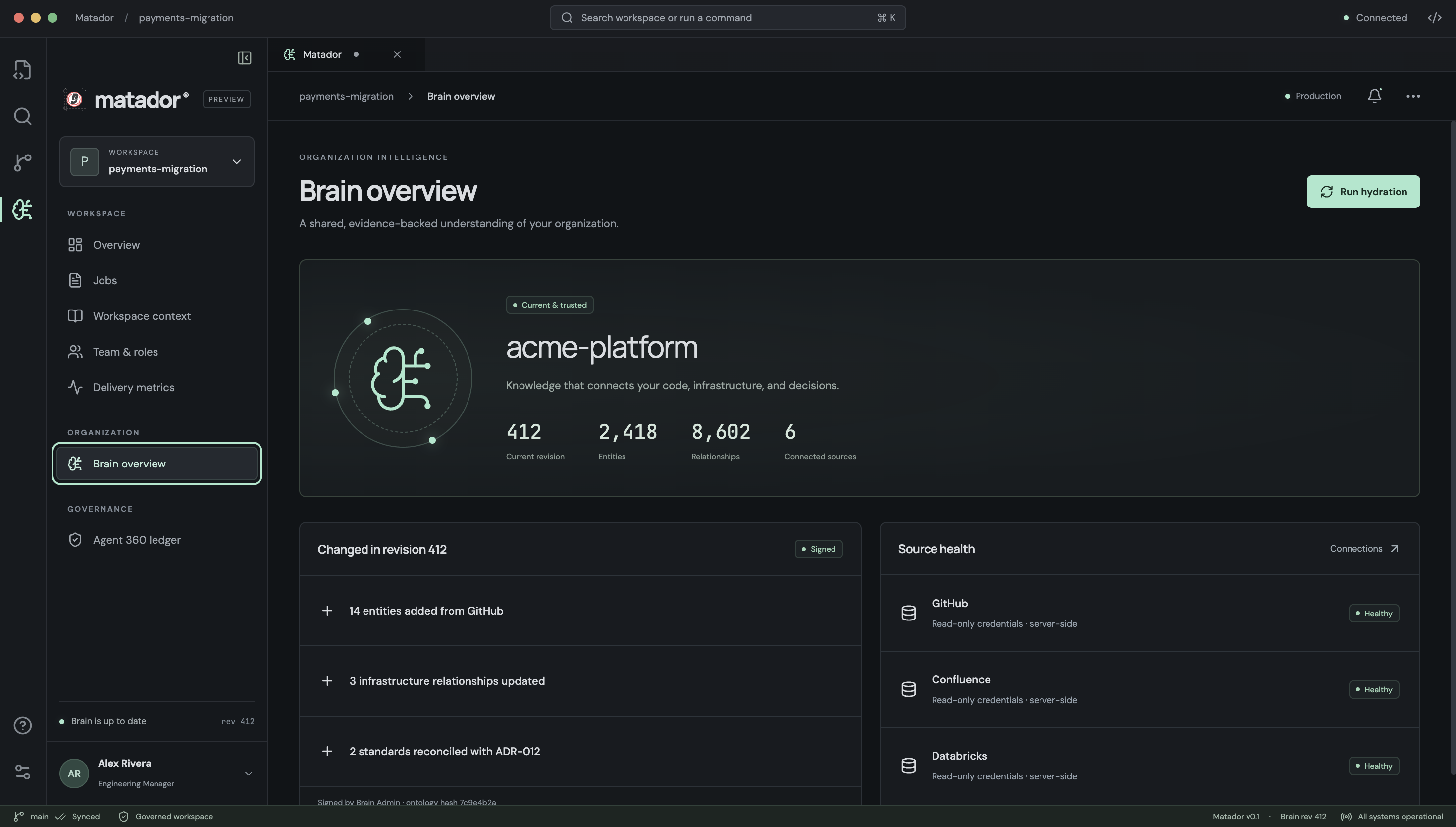
Your truth, your standards — a multidomain knowledge graph every agent draws from, so output matches how your teams already build.
Explore BrainCoordinated agent squads work across the full life cycle, each grounded in the Brain — so adoption finally turns into throughput.
Meet the agentsQuality assurance pipelines are agentized. Secrets, PII and PHI checks are enforced at review and again at deploy.
See the gatesExplainable, auditable AI. Every change is captured with its reasoning — fewer reviews, less remediation, nothing a black box.
Open the ledgerWe built our workload migration product with Matador, then measured the result.
Based on our own product build and testing. Methodology on request.
Every agent works from the same facts, inside your rules, and leaves a record. Click a layer for the Platform, or a stage for How it works.
Impact forecast: planning-time blast radius, before any code is written
Sample Use Cases
Teardowns and notes from real engagements.
DartIQ Matador is an agentic SDLC system that gives AI coding agents shared context (the Brain), enforced rules (quality gates), and a replayable record (the Agent Ledger 360). Engineers approve plans and releases, and agents do the work between approvals, so teams ship governed, production-ready code faster.
Faster code generation moves the bottleneck to review, validation, and rework. Studies show development activity up 59% while code reaching production moved between -7% and +12%, and 44% of AI-generated code carries a security flaw. Matador targets that gap with shared context, enforced gates, and a record of every change. Sources are listed in the problem section above.
Coding assistants help one engineer write code faster. Matador works around them: every agent gets the same context, every change is checked against your rules, and every action is recorded. It does not replace the assistants your teams use.
Matador checks changes against your standards as code is written, at review, and again at deploy, including secrets, PII, and PHI checks. A blocked change waits for a person, and every gate result is recorded in the Agent Ledger 360 with the rule that applied and who approved it.
Matador breaks the request into tickets with clear "done means" checks, asks the questions people should decide (delete or anonymize, signed contracts, legal holds), plans the safe deletion order, and blocks the change if the code contains passwords. See the stage-by-stage walkthrough on How it works. This is an illustrative walkthrough until the live run is recorded.
Matador is priced by workflows used, such as planning, coding, testing, and deploying, not by agent activity.
Start with a two-week, read-only baseline of how work flows today, then a 30-day pilot with one team inside your standards and gates. You decide whether to scale from your own numbers.
Yes. Matador covers building new applications and modernizing existing ones: VMware and container migration, Java application modernization, and database moves such as Databricks to BigQuery. Each use case is labeled delivered, in pilot, or in proposal.
A 30-minute session against your environment: your standards, your gates, your baseline cost — and the harness that closes the gap.